Why Every Song I Write Is About Pittsburgh
How Pittsburgh shapes every song Jay Trainer writes — on the rivers, the bridges, the hills, and making folk music in a city that rewards patience over ambition.
Pittsburgh isn't a backdrop for my music — it's a co-writer. The rivers teach you about flow and patience. The bridges teach you about connection. The hills teach you that the best things are hidden and worth finding. Every song I've written is a conversation with this place.
I didn't choose to write about this city. That's the honest answer, and it's the one I keep arriving at no matter how many times someone asks the question. I didn't sit down one day and decide that Pittsburgh would be the subject of my music. What happened was simpler and stranger than that: the city wrote itself into every song I made, and by the time I noticed, it was too late to separate the two.
I've written about this before — about place and memory and what it means to stay in a city that doesn't ask you to be anything other than what you are. But I've never gone all the way into the specifics. The geography. The water. The steel and the fog and the particular way the light hits the Allegheny River at six in the morning in October. This is that essay. This is the map.
The City That Writes Itself Into Songs
There's a theory in folk music that songs don't come from songwriters — they come from places. The songwriter is just the person who happens to be standing there when the song rises up out of the ground. I used to think that was romantic nonsense. Now I think it might be the truest thing anyone's ever said about the craft.
Pittsburgh is a city that insists on being noticed. Not loudly, not the way New York or Los Angeles insists on being noticed — not with spectacle or volume. Pittsburgh insists quietly. It does it with fog. It does it with the way the rivers carve through the middle of everything, so that no matter where you're going, you have to cross water to get there. It does it with hills that block your view and then, when you finally climb to the top, reward you with a sight that stops your breath.
You can't live here and not write about it. The place is too specific, too strange, too layered. It gets into your chord progressions. It shapes the way you think about tempo and silence. A song written in Pittsburgh doesn't sound like a song written in Nashville, and that's not because of the recording equipment or the studio or the musicians. It's because of the rivers and the bridges and the way the fog rolls in off the water and turns everything soft.
The Three Rivers
The Allegheny comes from the north. The Monongahela comes from the south. They meet at the Point — the very tip of downtown, where Fort Pitt once stood — and they become the Ohio, which flows west toward the Mississippi and eventually the sea. Three rivers, one confluence, and the whole city arranged around that single fact of water.
I think about those rivers constantly when I'm writing. Not always consciously — it's not like I sit down and say, "This verse is about the Monongahela." But the rivers are in the music the way they're in the city: underneath everything, shaping the landscape even when you can't see them.
The title track of Of The Sun — that song is about light, ostensibly. About the sun rising over the city. But the light in that song is river light. It's the way the morning sun catches the surface of the Allegheny and turns it into something that's half water, half fire. I didn't write that image. I saw it from the Hot Metal Bridge one morning in September, and it stayed in my chest until it turned into a melody.
Rivers teach you things about songwriting that nothing else can. They teach you about flow — not the overused creative buzzword, but the actual physical reality of water moving through a landscape. A river doesn't rush. It doesn't stop. It finds the path of least resistance, and it takes it, and over time it carves something permanent into the earth. That's what I want a song to do. I want it to find its own path and carve something into the listener that wasn't there before.
The Mon — that's what we call the Monongahela, because nobody here has time for five syllables — runs through the old mill towns south of the city. Homestead. Braddock. McKeesport. Those towns were built on steel, and when the steel left, the river stayed. There's a lesson in that, too. The industry comes and goes. The water remains. I try to write songs that have more river in them than steel.
446 Bridges
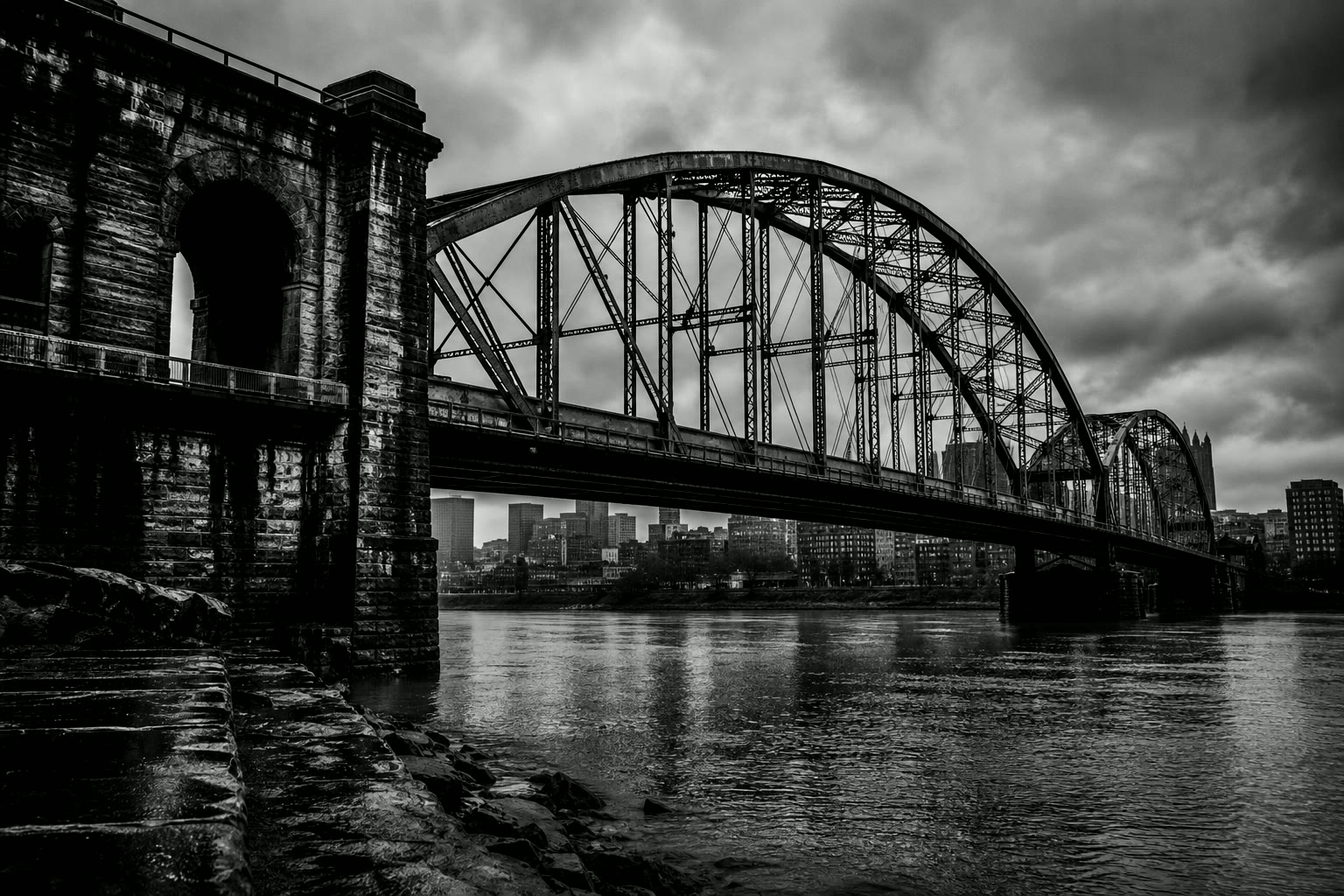
Pittsburgh has 446 bridges. More than any other city in the world, including Venice. I've walked across most of them. I've driven across all of them. And I've written songs on at least a dozen, standing in the middle of a bridge at night with the city lights reflected in the water below and a melody forming in the back of my skull.
A bridge is a metaphor so obvious it almost doesn't work. Connection. Spanning the gap. Getting from one side to the other. But when you live in a city with 446 of them, the metaphor stops being a metaphor and starts being a fact of daily life. You can't get anywhere in Pittsburgh without crossing a bridge. You can't get from the North Side to downtown without crossing the Allegheny. You can't get from the South Side to Oakland without crossing the Monongahela. The bridges aren't decorative. They're necessary. The city doesn't function without them.
I think about that when I'm building a song. The verses are neighborhoods. The chorus is the bridge — not in the musical sense, but in the structural sense. It's the thing that connects one side to the other, the thing that lets you cross the water and arrive somewhere new. And like a real bridge, it has to be strong enough to hold the weight of what's crossing it.
Lovely In Black came from a night walk across the Andy Warhol Bridge — the one with the blue suspension cables that leads from the North Shore to downtown. It was January. The city was dark and cold and beautiful in the way that only cold cities can be beautiful. The Three Sisters bridges were lit up to my left. The skyline was reflected in the river. And the song started forming — not the lyrics, not yet, but the feel of it. The atmosphere. The particular shade of darkness that Pittsburgh wears in winter.
The Hills
Pittsburgh is built on hills the way other cities are built on grids. There's no logic to it, no order. The streets follow the ridgelines and the valleys, and they twist and turn and dead-end into overlooks you never knew existed. You can live here for twenty years and still discover a street you've never seen, a staircase cut into a hillside that leads to a neighborhood you didn't know was there.
The hills hide things. That's what I love about them. In a flat city, you can see everything at once. There are no secrets. But in Pittsburgh, every hill is a wall, and behind every wall is something you have to earn the right to see. You have to climb. You have to work for the view.
The inclines on Mount Washington — the Duquesne and the Monongahela, two of the last remaining funiculars in the country — they carry you up the side of the mountain to Grandview Overlook, and when you step out at the top, you see the whole city spread out below you. The Point. The rivers. The bridges. The stadiums. The old steel infrastructure rusting beside glass towers. It's one of the great American views, and almost nobody outside of Pittsburgh knows it exists.
Wide Open Eyes — that song is about that view. Not literally, not in the lyrics, but in the feeling. It's about the experience of seeing something vast and layered and realizing you've only been looking at a small piece of it. The song opens up the way the view from Grandview opens up: slowly, then all at once. I wrote the first verse in my living room, but the chorus came to me standing at that overlook at dusk, watching the city lights come on one by one, the rivers turning from silver to black.
The hills also do something to sound. They create valleys and hollows where sound behaves differently. A freight train on the river sounds different from the top of Polish Hill than it does from the Strip District. The echo changes. The distance changes. When I'm arranging a song, thinking about reverb and space and how much room to leave between the notes, I'm thinking about hillside acoustics. I'm thinking about how a voice carries across a hollow.
A Music City That Doesn't Know It
Nashville knows it's a music city. Austin knows it's a music city. They have the infrastructure, the industry, the mythology. People move there to be discovered. People move there to make it.
Nobody moves to Pittsburgh to make it in music.
And that, I've come to believe, is the greatest gift this city gives its songwriters. The freedom of being ignored. The luxury of not having an industry breathing down your neck, not having A&R people in the audience, not having to think about whether a song is commercially viable or fits a format or appeals to a demographic. In Pittsburgh, you write the song because the song needs to be written. That's it. There's no other reason.
I've watched what the industry does to songwriters in Nashville. I've seen friends move to Austin and start writing songs that sound like everyone else's songs — not because they lost their voice, but because the pressure to conform is so enormous that it reshapes you without your permission. In Pittsburgh, there's no pressure to conform because there's nothing to conform to. There's no scene to break into, no ladder to climb, no gatekeepers to impress.
What there is: a community. Quiet, stubborn, supportive in the way that Pittsburgh people are supportive — which is to say, without fanfare. People show up to your shows. People buy your records. People don't care if you're famous. They care if the songs are good. And that's a kind of honesty that you can't buy and you can't manufacture and you can't find in a city that's organized around the music business.
The Neighborhoods
Pittsburgh isn't one city. It's ninety neighborhoods stitched together by bridges and bus routes, and each one has its own character, its own history, its own sound.
The Strip District on a Saturday morning is chaos and beauty in equal measure. Vendors shouting, fish on ice, produce stacked on sidewalks, the smell of Pennsylvani Macaroni Company mixing with exhaust fumes and river air. I've written more songs walking through the Strip than anywhere else — not about the Strip specifically, but with its rhythm in my head. The pace of it. The way a dozen conversations overlap and create a kind of accidental music.
Lawrenceville has changed more than any neighborhood in the city. When I first started playing shows there, it was dive bars and empty storefronts. Now it's galleries and craft cocktail places and tech startups. But the bones are the same. The row houses are the same. The way Butler Street runs straight and narrow like a song with no chorus — that's the same. I've played in living rooms and basements in Lawrenceville that had better acoustics than any venue I've ever been in. The old buildings have thick walls and hardwood floors and they do something to a voice that you can't replicate in a studio.
The South Side is where I learned to play in front of people. Carson Street on a Friday night, moving from bar to bar, playing for audiences that were half drunk and entirely honest. If a song didn't work on the South Side, it didn't work anywhere. Those crowds taught me more about songwriting than any book or workshop ever could. They taught me that a song has about thirty seconds to earn the right to keep going.
And Mount Washington — I keep coming back to Mount Washington. Because the view from up there isn't just a view. It's a perspective. It's the ability to see the whole city at once, to understand how the pieces fit together, to see the rivers and the bridges and the neighborhoods as one interconnected thing. That's what I want the albums to feel like. Not a collection of individual songs, but a view from a height — everything connected, everything part of the same landscape.
Why I Stayed
People leave Pittsburgh. They always have. The steel mills closed, and people left. The economy shifted, and people left. The winters got long, and people left. Every generation, the same story: the young ones go to New York or Chicago or somewhere warmer, somewhere with more opportunity, somewhere that feels like the future instead of the past.
I know that story because I lived part of it. I spent twenty years on the West Coast, long enough to love pieces of it and long enough to know it wasn't the ground under my songs. Years ago I made my way back to Pittsburgh because this place felt less like a choice than a recognition. This is home. This is bedrock. This is who I am.
I came back because the music kept telling me to come back. Every time I thought about place as something optional, I'd write a song that could only have been written here, and I'd realize that the work and the city were the same thing. You can't separate them. Take me out of Pittsburgh and the songs would change — not improve, not decline, but become something fundamentally different. Something with less fog in it. Less river. Less of that particular Pittsburgh quality of revelation through patience.
The Southern Winds — the opening track on the deluxe edition — was written and recorded in San Francisco, but the wind in that song still points home. It's about wind moving through valleys. Pittsburgh valleys. The way the air channels between the hills and creates these corridors of movement that you can feel on your face when you're standing on a bridge.
I stayed because Pittsburgh rewards staying. It doesn't give itself up easily. It's not a city you can understand in a weekend visit or a year-long residency. It takes decades. It takes winters. It takes getting lost on hills you thought you knew and finding streets that don't appear on any map. The city reveals itself slowly, and the songs that come from it are the same way — slow-burning, layered, revealing themselves over time.
What Pittsburgh Teaches Songwriters
If I had to distill everything this city has taught me about writing songs into a handful of lessons, they would be these:
Patience. The rivers don't rush. The fog lifts when it's ready. The view from Grandview Overlook has been there for ten thousand years, and it'll be there long after every song I've written has been forgotten. Write for the long game. Write songs that get better with time, not worse.
Humility. Nobody in Pittsburgh cares that you're a songwriter. Your neighbor cares that you shoveled your sidewalk. The guy at the coffee shop cares that you said good morning. The city doesn't care about your art — it cares about your character. And that distinction, that insistence on substance over performance, makes the art better.
Specificity. The more specific the geography, the more universal the song. A song about a river is vague. A song about the Allegheny River at six in the morning in October, when the fog is sitting on the water like a second surface and the light is turning everything gold — that song belongs to a place, and because it belongs to a place, it belongs to everyone who's ever stood beside any river at any dawn and felt the world go quiet.
Layering. Pittsburgh is a city built in layers — geological, historical, architectural, cultural. The rivers carved the valleys. The steel built the infrastructure. The immigrants built the neighborhoods. The artists are building whatever comes next. A good song works the same way. It has layers. The melody is the river. The lyrics are the bridges. The arrangement is the hillside. And somewhere underneath all of it, there's bedrock — the thing the song is really about, the thing you can't see but can feel holding everything up.
Connection. Four hundred and forty-six bridges. Every one of them built because someone needed to get from one side to the other. Every song is a bridge, too. Between the songwriter and the listener. Between the present and the past. Between the specific and the universal. Between this neighborhood and the one across the river that you can see from your window but have never visited.
I don't know if I'll ever write a song that isn't about Pittsburgh. I've tried. I've written songs that are ostensibly about love or loss or the passage of time or the particular way a person looks when they think nobody's watching. But the rivers are always in there somewhere. The fog is always rolling in. The hills are always hiding something worth finding.
The songs will always come back to this place. Not because I choose to bring them back, but because this is where they live. This is the ground they grew out of. And like the rivers, like the bridges, like the old steel bones of this city that refuse to disappear — they'll be here long after I'm done writing them. Waiting in the valleys. Waiting in the fog. Waiting for whoever comes next to find them and write them down.