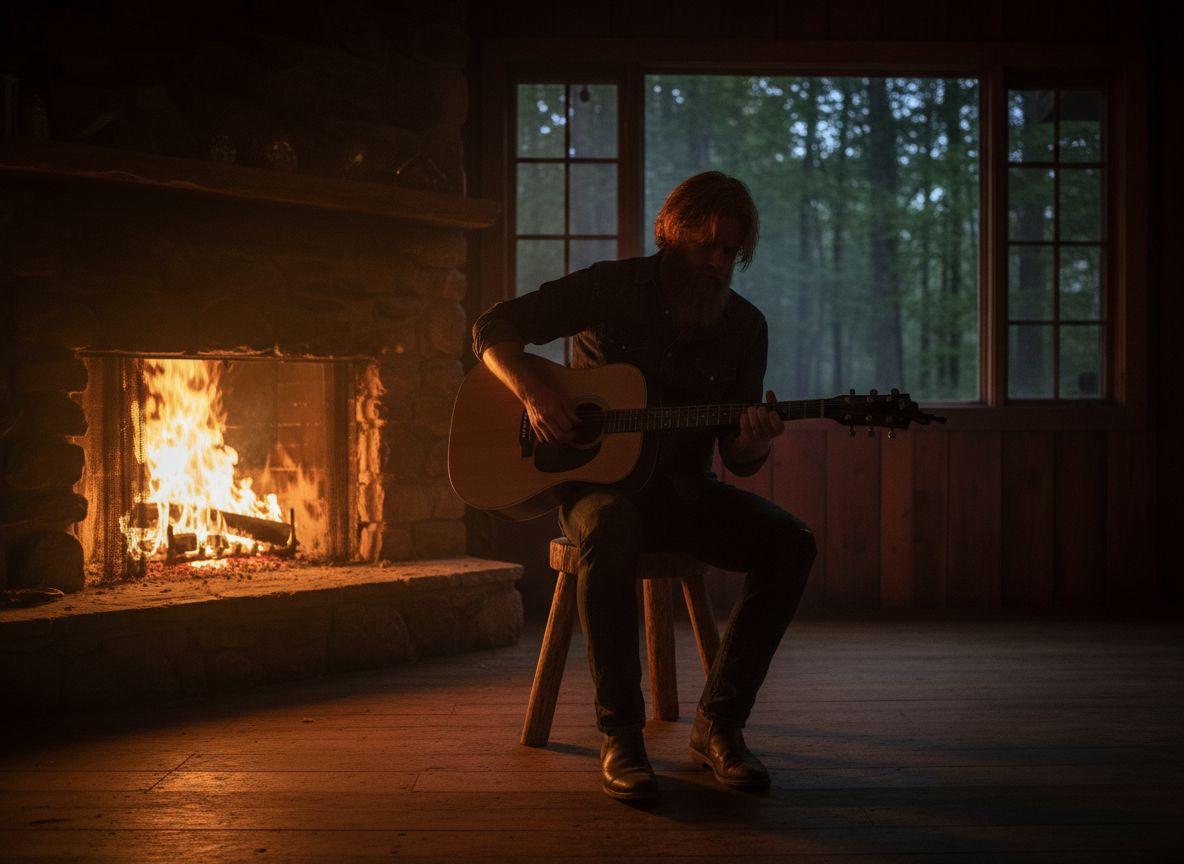
Five Songs That Changed How I Write
The five songs that shaped Jay Trainer's songwriting — from Townes Van Zandt and Chris Whitley to Neil Young and Gregory Alan Isakov. A personal essay on influence, craft, and what great songs teach you.
Five songs that rewired my approach to songwriting: Townes Van Zandt's 'Waitin' Around to Die,' Chris Whitley's 'Poison Girl,' Neil Young's 'Ambulance Blues,' Gregory Alan Isakov's 'San Luis,' and Bob Dylan's 'Boots of Spanish Leather.' Each one taught me something I couldn't have learned any other way.
Every songwriter has a handful of songs that rewired them. Not songs they loved or admired or wished they'd written — though those lists exist too, and they're long — but songs that actually changed the way they hear music. Songs that cracked open something they didn't know was closed.
These are mine. Five of them, anyway. There are others. There are always others. But these five are the ones I keep returning to when I'm lost, when I can't find the thread, when I've been staring at the same half-finished lyric for three hours and I need to remember why I started doing this in the first place. They are, in no particular order: Townes Van Zandt's Waitin' Around to Die, Chris Whitley's Poison Girl, Neil Young's Ambulance Blues, Gregory Alan Isakov's San Luis, and Bob Dylan's Boots of Spanish Leather.
Each one taught me something I couldn't have learned any other way. Not from a book, not from a workshop, not from another songwriter explaining their process over drinks. These lessons only arrive through the song itself — through the act of listening so deeply that the song starts to change you from the inside.
1. Townes Van Zandt — Waitin' Around to Die
I was nineteen, maybe twenty. I was sitting on the floor of a friend's apartment in Pittsburgh — the kind of apartment where the radiator clanks all night and the walls are thin enough to hear the neighbors argue — and someone put on a Townes Van Zandt record. I don't remember who. I don't remember which record. But I remember the moment Waitin' Around to Die started playing, because the room went quiet in a way that had nothing to do with volume.
Three chords. No chorus. No bridge. No clever turn of phrase designed to make you think the songwriter is smart. Just a man sitting with a guitar, telling you the story of his life in four verses, each one worse than the last. Codeine. Prison. Alcohol. A woman who left. And threaded through all of it, that refrain — not a hook, not a singalong, just a statement of fact delivered with the patience of someone who has already accepted what's coming.
It destroyed me. Not because it was sad — I'd heard sad songs before — but because it was plain. There was nowhere to hide in that song. No production to soften the blow, no metaphor to give you distance from the thing itself. It was just the truth, laid out on a table, and you could take it or leave it.
That was the first lesson: simplicity is devastating. Not simplicity as laziness, not simplicity as inability — simplicity as a choice. The choice to strip away everything that isn't essential and trust that what remains will be enough.
I think about Townes every time I write a song like The Southern Winds or Alibi. Songs where the arrangement is sparse enough that there's nowhere for the lyric to hide. Songs where if the words don't work, nothing works, because there's nothing else to carry them. That's a terrifying way to write. But it's honest. And I learned it from a man on a scratchy recording, alone with a guitar, waiting around to die.
The other thing Townes taught me — and this took longer to understand — is that a song doesn't need a resolution. Waitin' Around to Die doesn't end with redemption. It doesn't end with hope. It just ends. And somehow that's more true than any uplifting final verse could ever be. Some stories don't resolve. Some songs shouldn't either.
2. Chris Whitley — Poison Girl
If Townes taught me about restraint, Chris Whitley taught me about danger.
I found Poison Girl on a burned CD — remember those? — that a guitar player handed me after a gig at a bar in the South Side. "You need to hear this guy," he said. I didn't listen to it for weeks. When I finally did, I was driving across the Fort Pitt Bridge at night, and the opening of that song — that distorted, bent, almost broken guitar tone — hit me like a slap.
I pulled over. I actually pulled over.
Chris Whitley made acoustic music that felt dangerous. Not loud-dangerous, not punk-dangerous, but dangerous the way a river is dangerous when you can't see the bottom. Poison Girl is built on an open tuning that sounds like the guitar is trying to come apart. The vocal is intimate but unstable. The whole thing teeters on the edge of collapse, and that instability is the point. It's what makes the song feel alive.
Before Whitley, I thought folk music had to be gentle. I thought acoustic meant soft. I thought the guitar was a vehicle for the voice and nothing more. Poison Girl shattered all of that. It showed me that an acoustic guitar can be an instrument of texture and menace, that folk music can have teeth, that you can build a song on unease and dissonance and still have it be beautiful — maybe more beautiful, because the beauty is earned.
You can hear what Whitley taught me all over Blackout Asylum. That record was my attempt to find that same edge — to write songs that felt stripped down but not safe. The Clearing and Born Under A Bad Sign both came from a place where I was trying to make the guitar sound like something slightly wrong was happening, like the song might fall apart at any moment but somehow held together through sheer force of will.
Fractured is probably the most direct line from Whitley to my own work. The original version on Of The Sun has that same sense of tension — the guitar tuned just slightly off from where you expect it, the vocal pushing against the melody rather than settling into it. Every time I play it, I think of Whitley. Every time, I try to find that same edge without falling off it.
3. Neil Young — Ambulance Blues
Some songs teach you patience. Ambulance Blues taught me a kind of patience I didn't know existed.
I first heard it on vinyl — my father's copy of On The Beach, the jacket water-stained and the grooves noisy from years of play. I was maybe sixteen, and I remember being frustrated by the song. It was nine minutes long. It didn't seem to go anywhere. The harmonica came and went. The lyrics were cryptic, almost nonsensical. I couldn't find the hook. I couldn't find the chorus. I couldn't find the point.
So I listened again. And again. And somewhere around the fourth or fifth listen, the song opened up like a landscape you've been driving through suddenly revealing a valley you didn't know was there. The point of Ambulance Blues is the journey. The point is the sprawl itself — the way the song wanders from image to image, from feeling to feeling, trusting that if you follow it long enough, you'll arrive somewhere profound. And you do. The final verse lands with a weight that wouldn't be possible without the eight minutes of wandering that came before it.
That song gave me permission to write long. Not long for the sake of it — nobody needs a nine-minute song that should have been four — but long because some ideas need room to breathe, need time to unfold, need space to circle back and surprise you.
Everything We Never Said is a five-minute song that started as a two-minute song. I kept cutting it down, trying to make it efficient, trying to make it tight. And it kept dying on me. It wasn't until I let it sprawl — let it breathe between the verses, let the guitar take its time, let the silence do some of the work — that the song came alive. Neil Young taught me that. He taught me that efficiency isn't always a virtue, that sometimes the most direct path to an emotion is the long way around.
By Cover Of A Great Lie, which lives on A Whisper Of Ruin, is nearly six minutes long, and every second of that was a fight against my instinct to trim. But that song needed its length the way a river needs its bends. You can't straighten it without losing the thing that makes it what it is. I know that because of Ambulance Blues. I know that because a sixteen-year-old kid listened to a nine-minute song on a scratchy vinyl record and learned that patience is not the absence of movement — it's the willingness to let the movement take its own shape.
4. Gregory Alan Isakov — San Luis
The first time I heard San Luis, I thought something was wrong with my speakers.
The song starts so quietly — so buried in its own atmosphere — that I actually checked the volume. Turned it up. Pressed my ear closer. And then the song bloomed, slowly, the way fog lifts off a valley in the early morning. Not all at once. Not dramatically. Just gradually, until you realize you're surrounded by it.
I was in my living room — the same room where I record some of the later music, the room with the old plaster walls and the fireplace and the hardwood floors that creak when you walk too fast. And I remember thinking: this is what a room sounds like when it's part of the song.
Gregory Alan Isakov records in a barn on his farm in Colorado. You can hear it. Not literally — there aren't goats in the background — but you can hear the space. The air. The distance between the microphone and the walls. The room is an instrument in his music the way the guitar is, the way the voice is. And San Luis is the purest expression of that idea: a song where the atmosphere is not decoration but structure. Take away the reverb, the space, the breath between the notes, and you don't have a stripped-down version of the song. You have a different song entirely.
That changed everything about how I think about recording. Before Isakov, I thought of recording as capturing a performance. After Isakov, I thought of it as capturing a place. Every record I've made since has been shaped by that distinction, whether it was a San Francisco session with multiple musicians or a later room-first recording back home. When I set up a microphone in my living room, I'm not just recording the guitar — I'm recording the room. The creak of the floor. The hiss of the radiator. The particular quality of silence that exists in this house, in this neighborhood, in this city.
You can hear it on Her Mind, which was one of the last songs recorded for the deluxe edition. That song is as much about the room it was made in as it is about anything in the lyrics. The warmth of the tone, the way the vocal sits slightly back in the mix, the sense that you're listening to someone playing in a real space rather than a controlled environment — all of that is intentional. All of that comes from Isakov.
San Luis also taught me about restraint in a different way than Townes did. Townes taught me to strip away. Isakov taught me to hold back. There's a difference. Stripping away means removing what's unnecessary. Holding back means having more to give and choosing not to give it yet. It's the difference between silence and a pause. San Luis is full of pauses — moments where the song could open up, could get louder, could add another instrument — and it never does. It just stays in that quiet, patient space, and the tension of what's being withheld becomes part of the music.
I think about that every time I'm tempted to add another track, another layer, another harmony. Sometimes the most powerful thing you can do is leave the space empty. Let the listener fill it with their own experience. Trust the room.
5. Bob Dylan — Boots of Spanish Leather
I saved Dylan for last because he's the one everyone expects, and I wanted to earn it before I said it.
There are a hundred Dylan songs I could put on this list. Boots of Spanish Leather is the one that changed how I write because it taught me something none of the others did: that a song can be a conversation.
The structure is deceptively simple. Two people, separated by an ocean. One is leaving, one is staying. They talk to each other across the verses — not in dialogue the way a play has dialogue, but in the way real people talk when they know something is ending and neither of them wants to be the one to say it. She offers to send him something from across the sea. He says he doesn't want anything, just her safe return. She writes again. He writes back. And each exchange peels away another layer of pretense until, in the final verse, he gives in and asks for the boots. Spanish leather. And in that small, specific, material request, you hear everything — the grief, the acceptance, the loneliness of someone who has finally stopped pretending they're fine.
I was probably twenty-two when that song clicked for me. I'd heard it before, but I hadn't listened. When I finally did, I realized that Dylan had built an entire narrative — a love story, a breakup story, a story about pride and surrender — without ever stepping outside the perspective of two people writing letters. No narrator. No commentary. No third verse where the songwriter steps back and tells you how to feel. Just two voices, trading lines, and the devastation that accumulates in the gaps between what they say and what they mean.
That's the hardest kind of writing there is. Dialogue without exposition. Emotion without explanation. And it taught me to think about songwriting as a conversation — not always between two people, but between the song and the listener, between the present and the past, between a place and the person shaped by it.
I've written about Pittsburgh as a collaborator, as something I'm in constant conversation with. That idea — that a song can be a dialogue between the writer and a place — comes directly from Boots of Spanish Leather. Because if Dylan could build a whole world out of two people talking, then I could build a song out of one person listening to a city. Out of a man sitting in a living room in Pittsburgh, playing a chord, and hearing the room answer.
Lovely In Black is the closest I've come to writing a true dialogue song. Two perspectives, two interpretations of the same story, neither one complete without the other. It's not as good as Boots of Spanish Leather — nothing is — but the impulse behind it is the same: the belief that a song is richer when it contains more than one voice, even if only one person is singing.
On Influence
People ask about influences and expect a straightforward answer. "I listened to X, and now I sound like X." But that's not how it works. Influence isn't imitation. It's absorption. It's the slow, unconscious process of letting someone else's art change the way you hear the world, so that when you sit down to make your own, you're drawing from a well that's deeper than you knew.
I don't sound like Townes Van Zandt. I don't sound like Chris Whitley or Neil Young or Gregory Alan Isakov or Bob Dylan. I sound like someone who listened to all of them and then sat in a room in Pittsburgh and tried to tell the truth. The lessons they taught me — simplicity, danger, patience, atmosphere, dialogue — those aren't techniques. They're permissions. Each one gave me permission to try something I was afraid to try, to trust something I was afraid to trust.
That's what great songs do. They don't teach you how to write. They teach you how to listen. And if you listen long enough, with enough attention and humility, the writing takes care of itself.
I'm still learning. Twenty years of songs and I'm still sitting on the floor, still pulling the car over, still pressing my ear closer to the speaker, still waiting for the next song that cracks something open. That's the deal. You never stop being a student. You just get better at knowing what to listen for.