The Gear Behind the Sound: Recording Folk Music at Home
A practical guide to recording folk and Americana music at home — from microphones and acoustic treatment to the philosophy of capturing honest performances in imperfect spaces.
Home recording folk music requires less gear than you think — a quality condenser mic, a simple interface, a room you know well, and the discipline to capture honest performances. The imperfections of home recording are features, not bugs.
You don't need a studio to make something real. You need a room that sounds like home, a guitar that's been with you long enough to know your hands, and the patience to press record when the moment arrives.
I've been recording folk music at home for nearly twenty years. Not because I set out to build a home studio — I didn't — but because the songs kept showing up at inconvenient hours and I needed a way to catch them before they disappeared. What started as a cheap microphone and a laptop became a practice, then a philosophy, then the way I've made almost everything in my catalogue.
Not every record in the catalogue was made that way. The Waking Hours, Of The Sun, Den Of Thieves, and A Whisper Of Ruin — Deluxe Edition were recorded in San Francisco, with all music written by Jay Trainer. The later home-recorded work is a different chapter: quieter, more intimate, and built around whatever gear I could fit into a room without turning it into a showroom.
If you're a singer-songwriter thinking about recording at home, here's what I've learned — practically, philosophically, and through a lot of trial and error.
The Room Comes First
Before you buy a single piece of gear, listen to your room.
I mean that literally. Sit in the space where you plan to record. Clap your hands. Play a chord. Sing a note and let it hang in the air. What do you hear? Is there a flutter echo between parallel walls? Does the low end pile up in the corners? Does the room ring, or does it absorb?
My living room has old plaster walls — the kind they don't build anymore, thick and slightly uneven, with decades of paint layered over horsehair and lime. Plaster is dense. It reflects sound differently than drywall. The mids come back warm. The highs scatter instead of bouncing straight back at you. The hardwood floors add brightness underneath everything, a kind of natural shimmer that I've never been able to replicate with EQ.
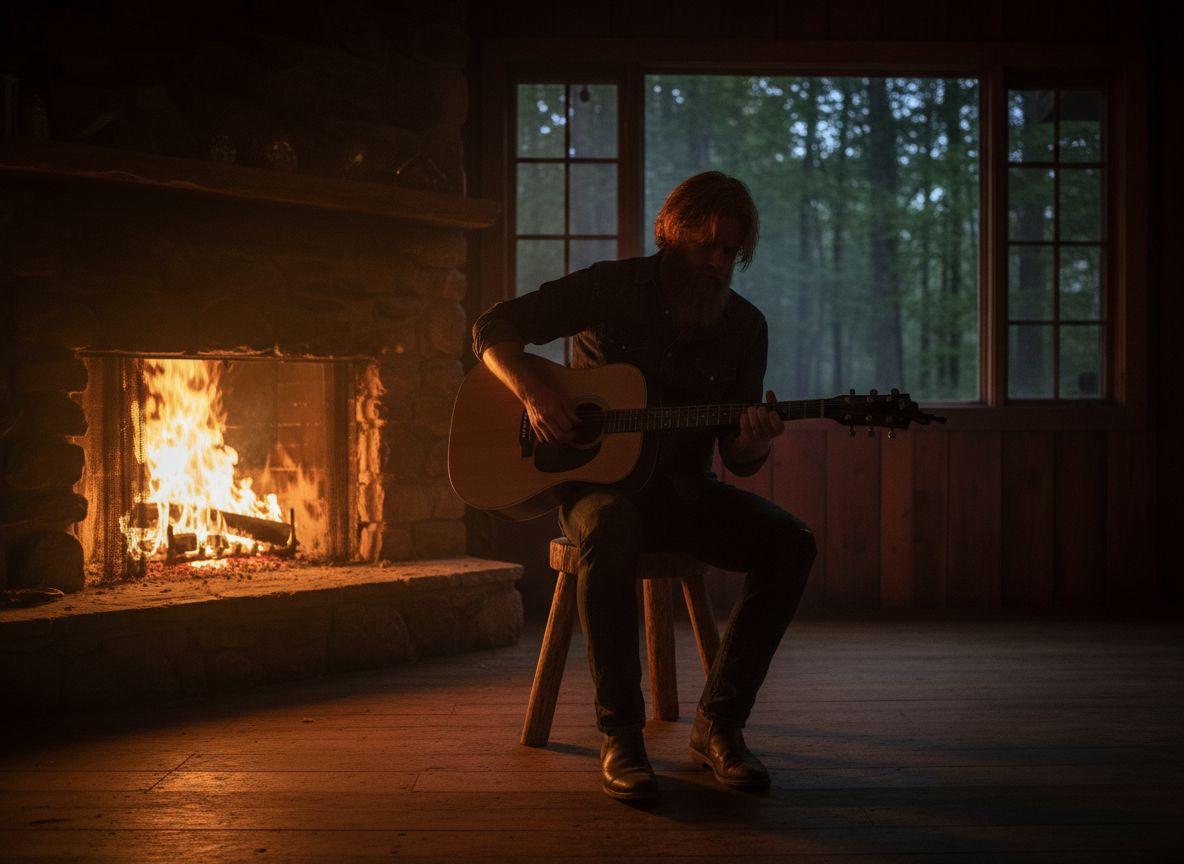
And then there's the fireplace. Not lit while I'm recording — I learned that lesson early, when the crackle of burning oak showed up louder than the guitar on a later acoustic take. But the fireplace itself, the stone and brick, the deep cavity of the firebox, it acts as a kind of natural bass trap. It breaks up the wall surface and scatters low frequencies that would otherwise build up and muddy the sound.
The point is this: every room has a sound, and if you're recording folk music — music that's supposed to sound human, lived-in, honest — the room is not an obstacle. It's an instrument. Learn it the way you'd learn a guitar. Learn where it resonates and where it deadens. Learn its moods at different times of day, because a room at midnight sounds different than a room at noon.
I wrote about this in the Deluxe Edition story — how the setting and the players shaped the record not just sonically but emotionally. The room is always part of the performance, whether that room is a San Francisco session space or a quiet room back home.
The Essentials: What You Actually Need
Here's the honest list. Not the aspirational list, not the "if money were no object" list. The list of what you actually need to make a folk record at home that sounds like it was made with intention:
- A quality large-diaphragm condenser microphone
- A two-channel audio interface
- A pair of closed-back headphones for tracking
- A DAW (recording software)
- A quiet room you know well
- Your instrument
- Patience
That's it. Everything else is refinement. You can spend thousands on preamps and compressors and acoustic treatment, and some of that spending will matter. But the foundation is simple: a good microphone, a clean signal path, a room, and a performance worth capturing.
Microphones: The One Choice That Matters Most
If you're only going to invest in one piece of gear, make it the microphone. For folk music — for acoustic guitar, for vocals, for the kind of intimate, close-miked recording that this genre demands — a large-diaphragm condenser is the right tool.
I've used a few over the years. The microphone I keep coming back to is a large-diaphragm condenser with a warm character — not overly bright, not hyped in the high frequencies the way some modern condensers are. Folk music doesn't need sparkle. It needs clarity and warmth. It needs to sound like a person in a room, not a voice floating in digital space.
For acoustic guitar specifically, I'll sometimes use a small-diaphragm condenser as a second mic — placed near the twelfth fret while the large-diaphragm handles the body of the guitar from about eight inches out. That two-mic setup gives you options in the mix: more body, more string detail, or a blend of both. But plenty of great recordings have been made with a single well-placed condenser. Fractured (Acoustic) on the Deluxe Edition was one mic, one take, one position. Sometimes simplicity is the whole point.
A note on dynamic microphones: they have their place. For louder performances, for harmonica, for anything where you want to reject room noise and focus tightly on the source, a good dynamic mic is invaluable. I keep one around for harmonica work and for those rare moments when I plug in the Gibson and need something that can handle the volume without the condenser overloading.
The Interface: Keep It Clean
The audio interface is the bridge between your microphone and your computer. It converts the analog signal — the actual sound waves your voice and guitar produce — into digital information your recording software can work with. The quality of that conversion matters, but here's the good news: even modest interfaces in 2026 have converters that would have cost thousands a decade ago.
What you want in an interface for home folk recording is simple: clean preamps with enough gain for a condenser microphone, low self-noise, and reliable drivers that won't crash mid-take. Two inputs are enough. One for the vocal mic, one for the guitar mic. If you're recording both simultaneously — which I often do, because separating the performance into isolated tracks can kill the feeling — two inputs is all you need.
I record guitar and vocals at the same time more often than not. Yes, there's bleed. The vocal mic picks up the guitar. The guitar mic picks up the voice. Some engineers would call that a problem. I call it the sound of a person playing and singing in a room, which is exactly what's happening, which is exactly what folk music is. The bleed is the glue. It's what makes a home recording sound like a home recording instead of a sterile assemblage of isolated tracks.
Recording Acoustic Guitar
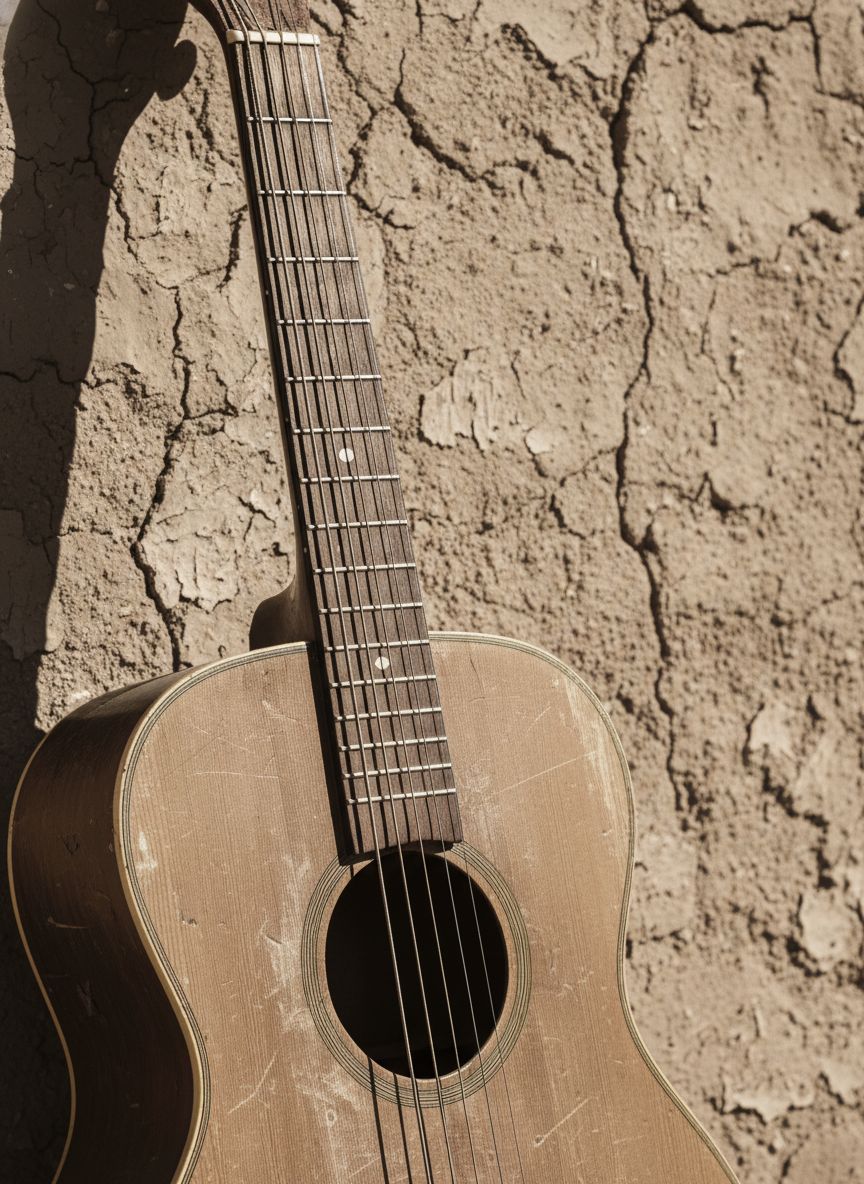
The Martin has been with me longer than most of the people in my life. It's a dreadnought, spruce top, rosewood back and sides, and it's been played so much that the top has opened up in a way that new guitars simply can't replicate. There's a complexity in the low mids, a woody overtone that only comes from years of vibration loosening the grain of the wood. The guitar remembers every song I've ever played on it.
For recording acoustic guitar at home, microphone placement is everything. More important than the microphone itself, more important than the preamp, more important than the room treatment. Move the mic two inches and you've changed the entire character of the recording.
My starting position: the microphone pointed at the spot where the neck meets the body, about eight to ten inches away, angled slightly toward the sound hole. This gives you a balanced tone — enough bass from the body, enough string definition from the neck, without the boomy resonance you get when you point straight at the sound hole.
From there, I adjust by ear. Every guitar is different. Every song asks for something different. A fingerpicked ballad might want the mic closer, capturing the intimacy of the fingers on the strings. A hard-strummed anthem might want more distance, letting the room fill in around the guitar.
The key is to move the microphone, not reach for the EQ. If it doesn't sound right at the source, no amount of processing will fix it. Get it right in the room.
Capturing Vocals
Vocal recording at home is where most people get nervous, and I understand why. Your voice is the most vulnerable thing you'll ever put on tape. It's you — unprocessed, unprotected, standing in your living room at midnight trying to sing something true.
The practical side: sing about six to eight inches from the microphone. Use a pop filter — a simple mesh screen between your mouth and the mic — to catch the plosive bursts on P and B sounds that would otherwise overload the capsule. Angle the mic slightly off-axis if you're a loud singer, or move in closer if you're whispering.
But the real secret to recording vocals at home isn't technical. It's emotional. You have to forget the microphone is there. You have to stop performing and start being. The best vocal takes I've ever captured — the ones on Everything We Never Said, on Her Mind, on Lovely In Black — those weren't performances. They were moments. I pressed record, I sang the song the way I'd sing it if nobody was ever going to hear it, and something happened in the room that I couldn't have planned.
This is the advantage of recording at home that no studio can match: you're alone, you're comfortable, there's no clock running, there's no engineer watching through glass. It's just you and the song and the room. That's when the real stuff comes out.
The One-Take Philosophy
I believe in one takes. Not exclusively — I'll do multiple passes when a song demands it, when I'm learning something new about the arrangement, when I haven't found the tempo yet. But when it feels right — when the room is warm and the guitar is in tune and the words are sitting where they belong — I press record and I play the song from beginning to end without stopping.
Lifeline was one take. Fractured (Acoustic) was one take. Some of the best moments on A Whisper Of Ruin were first or second takes where something clicked and the song played itself.
There's a quality in a one-take recording that you can't manufacture through editing. A continuity of breath, of tension, of emotional arc. The song builds the way it builds because a human being was building it in real time, making decisions with their body instead of their mind. You can hear when a recording was assembled from pieces, even if the assembly is seamless. The life goes out of it. It becomes correct instead of true.
Folk music, more than any other genre, rewards this approach. The tradition of folk is the tradition of a person in a room, playing a song all the way through, making it live and breathe in a single unbroken gesture. Home recording lets you honor that tradition in a way that commercial studios — with their punch-ins and comp tracks and endless options — often don't.
Mixing Philosophy: Less Is Almost Always More
Mixing folk music should be an act of subtraction, not addition. The performance is the thing. The room is the thing. Your job in the mix is to present what was captured, not to transform it into something it wasn't.
Here's my approach: I set the levels so the vocal sits naturally on top of the guitar. I might add a touch of EQ — a gentle high-pass filter to clean up any low-end rumble below the guitar's fundamental, a small presence boost in the upper mids to help the vocal cut through. I might add a short, subtle reverb if the room sound isn't enough on its own, though usually it is.
What I don't do: I don't compress the life out of the vocal. I don't auto-tune. I don't layer effects until the recording sounds like it was made in a space that doesn't exist. The whole point of recording at home is that you recorded it at home — in a real room, with real acoustics, with all the imperfections and beauty that implies.
The slight unevenness in the vocal level? That's called dynamics, and it's what makes a performance feel alive. The sound of the pick on the strings between notes? That's texture. The faint hum of the house settling, the distant sound of a car passing on the street outside? That's context. That's the world the song lives in.
I'd rather have a recording with character than a recording with perfection. Perfection is for machines. Character is for music.
Acoustic Treatment: The Practical Minimum
You don't need to turn your living room into an anechoic chamber. That would defeat the purpose — you want the room sound, remember? But a few practical steps can help tame the worst problems.
If you have hard, parallel walls that create flutter echoes, a heavy blanket or a bookshelf full of books on one side will break up the reflection. Bookshelves are the most underrated acoustic treatment in the world — all those different-sized objects scatter sound in unpredictable, natural ways.
Corners are where bass builds up. If your recordings sound muddy and boomy, try pulling your recording position away from the corners and the walls. Even a foot or two of distance makes a difference.
Carpets and rugs help control floor reflections. I have a thick wool rug under my recording spot. It does double duty — keeps my feet warm during late-night winter sessions and keeps the floor reflections from smearing the stereo image.
But don't over-treat the room. A dead room — one with so much absorption that there's no natural reverberation at all — sounds lifeless and claustrophobic on recording. You want some room sound. You just don't want the room fighting you.
Why Home Recording Matters
There's a myth that real music requires a real studio. That you need a control room and a live room and a mixing console and an engineer who's worked with names you recognize. That myth keeps a lot of people from making the music they're carrying around inside them.
Here's what I know after twenty years: the room matters, but the song matters more. Some records came from San Francisco sessions with multiple musicians. Some later recordings came from a living room in Pittsburgh, ten feet from a couch with a blanket on it. The common thread is the same: all music written by Jay Trainer, captured in the place and with the people that served the song best.
You don't need permission to make music. You don't need a studio. You don't need expensive gear or an engineering degree or someone else's validation that your space is "good enough." Your space is good enough if the songs are good enough. The gear is secondary. The room is secondary. The only thing that's primary is the performance — the moment when you sit down with your instrument and sing something that matters, and you're brave enough to press record.
The best recording setup in the world is the one that gets out of your way and lets you make the music. For me, that's a living room with a fireplace, a Martin guitar that knows my hands, a microphone that tells the truth, and the willingness to sit in the quiet and wait for the song to show up.
Start there. The rest is just refinement.